Fabric Guide
The compositions behind the range, what each one is for, and how it behaves after the fiftieth wash.
Last updated 28 October 2026
The fabric decides how a uniform behaves over a twelve-hour shift: how it stretches when you lift a patient, how it dries, how it holds colour after fifty washes. Every aaoms garment lists its exact composition on the product page. This page explains what those numbers mean in practice.
The fabric families we use
| Fabric | Composition | Used for | Behaviour |
|---|---|---|---|
| Classic poly-cotton | 65% polyester, 35% cotton | Classic scrubs, nursing uniforms, aprons | Holds shape and colour, resists creasing, dries quickly, minimal shrinkage |
| Poly-cotton poplin | 65% polyester, 35% cotton, tight weave | Lab coats | Smooth, crisp drape with a clean white finish |
| 4-way stretch | 78% polyester, 18% rayon, 4% spandex | Premium and jogger scrubs | Stretches along and across the cloth, recovers its shape, soft against the skin |
| Premium stretch | 75% polyester, 20% rayon, 5% spandex | Stretch scrub sets | More give and a softer hand than classic cloth |
| OT grade | 67% polyester, 33% cotton, dense weave | OT wear, surgical gowns | Tight weave that stands up to repeated institutional laundering |
| Fluid-resistant | 100% polyester with a fluid-resistant coating | Protective aprons and covers | Sheds splashes; the coating is a barrier, not a substitute for PPE |
| Combed cotton jersey | 100% combed cotton, 180 GSM | T-shirts | Breathable everyday knit with a clean print surface |
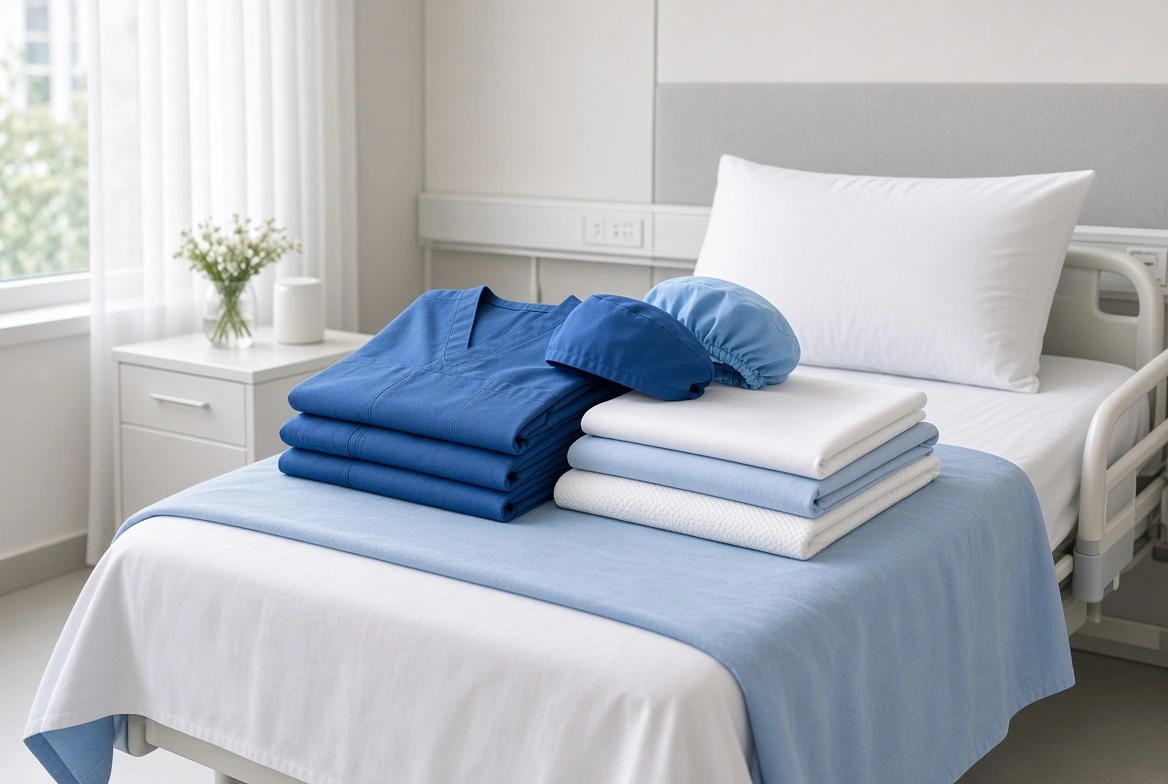
| Percale | 60% cotton, 40% polyester | Bed sheet sets | Crisp, cool and quick to dry |
Why stretch matters
A scrub that does not move with you pulls at the shoulder when you reach across a bed and rides up when you crouch. Two-way stretch helps in one direction; four-way stretch moves with the body in both. The spandex percentage is deliberately modest so the garment recovers instead of growing baggy by lunchtime.
Colour and dyeing
Our clinical colours are vat-dyed, which is why they hold through hospital washing better than surface-dyed cloth. Even so, two batches of the same shade can differ slightly. Bulk orders are cut from a single dye lot so a ward looks consistent; reorders placed months later may sit a shade away, and we will tell you when that is likely.
The 45 mill-coded swatches in the fabric library are photographed from the actual cloth. The mill code, not the screen colour, is the reliable identity of a shade.
Weight and GSM
GSM is grams per square metre. Lower numbers feel lighter and dry faster; higher numbers feel denser and hang with more weight. Where a product page gives a GSM, treat it as a guide to hand-feel rather than a measure of quality on its own.
Thread and embroidery
Embroidery is stitched with Madeira polyester thread, chosen because it holds colour through industrial washing and does not shrink away from the cloth. Thread shades are matched to the garment or to your brand colour, and we confirm the match on the digital proof before production.
Shrinkage and pilling
- Poly-cotton blends shrink very little; expect under 2% on the first wash.
- Cotton-rich knits relax slightly and may shrink up to 3% in a hot wash, which is why we recommend cold.
- Pilling on stretch fabrics comes from friction, not from the fabric failing. Washing inside out and avoiding a hot dryer reduces it.
- Fluid-resistant coatings degrade with bleach, fabric softener and very hot water.
If you need a fabric for a specific requirement, such as a colour match for an existing uniform or a heavier cloth for theatre use, send the requirement with your bulk brief and we will tell you what is possible before you commit.
Still need help?
Mon–Sat, 10am – 6pm IST. Message us on WhatsApp or write to aaomsindia@gmail.com and we will reply with the next step for your order.